
COD vs. Prepaid: What Indian Shoppers Prefer and Why It Matters for Your Reselling Business
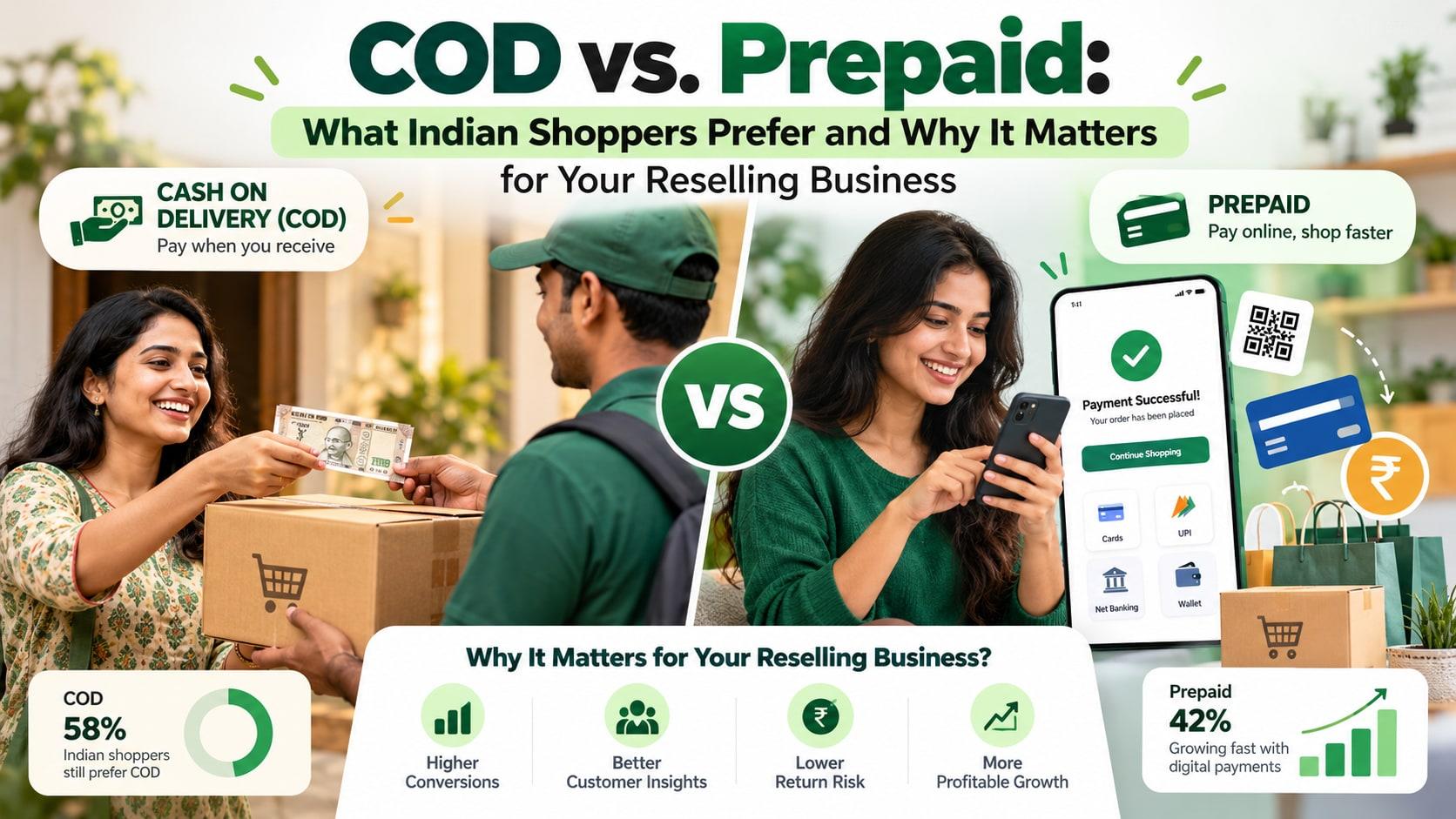
Discover the truth about COD vs prepaid payments in India. Learn real 2025 data on RTO rates, buyer psychology, and proven strategies to protect your reselling profits.
India's e-commerce story has always been unique. While the rest of the world moved swiftly to card payments and digital wallets, Indian shoppers held on to something familiar, Cash on Delivery. Even today, as UPI transactions cross billions every month and smartphones reach every corner of the country, COD refuses to fade away.
If you are a reseller or a small business owner selling online in India, understanding the COD vs prepaid debate is not just academic. It directly affects your profits, your returns, and your long-term growth. Let's dig deep into the numbers, the psychology, and the strategy.
What Is COD and Prepaid? A Quick Recap for Indian Sellers
Cash on Delivery (COD) means the customer pays only when the product reaches their doorstep. No upfront commitment. No digital transaction required.
Prepaid orders require the customer to pay at checkout via UPI, debit/credit card, net banking, or digital wallets like PhonePe and Google Pay before the product is even dispatched.
Both options are widely available across Indian e-commerce platforms, but they behave very differently for sellers.
COD in India: Still the King
Here is a number that surprises most people outside India: 60–65% of all e-commerce orders in India are still placed via Cash on Delivery as of December 2025. Despite the meteoric rise of UPI, despite the Digital India push, and despite the growing comfort with online transactions, COD still dominates.
Why? Because India is not one market. There are many markets layered on top of each other.
In metro cities like Mumbai, Bengaluru, and Delhi, a large chunk of shoppers comfortably pay online. But in Tier-2 and Tier-3 cities, places like Gorakhpur, Rajkot, Tirunelveli, and Silchar COD are not just preferred. It is the only option many shoppers feel comfortable with. These are the cities that are fuelling the next wave of e-commerce growth in India, and for resellers on social commerce platforms, this is your core audience.
The reasons are deeply rooted:
Trust deficit: First-time online shoppers fear fraud. COD feels like an insurance policy. "If it's wrong, I simply won't pay."
No digital payment access: Not everyone has a smartphone with UPI set up, especially among older demographics.
Product inspection habit: Indian shoppers are accustomed to touching and feeling products before buying. COD replicates that sense of control.
Past bad experiences: A friend or family member who got a wrong product and struggled to get a refund is enough to make someone stick to COD for years.
The Dark Side of COD: RTO and What It Costs You
Here is where things get uncomfortable for resellers. COD comes with a serious hidden cost called RTO [Return to Origin].
RTO happens when an order is shipped but not successfully delivered either because the customer refused it, wasn't available, gave a wrong address, or simply changed their mind. The parcel comes back to you, and you pay shipping charges both ways without earning a rupee.
The numbers are alarming:
COD orders see an RTO rate of 25–30%, while prepaid orders have an RTO rate of less than 2%
In social commerce specifically, RTO rates can climb as high as 35–40%
Indian e-commerce businesses collectively lose over ₹20,000 crore annually due to high RTO rates and failed deliveries
Orders in the ₹500–₹1,000 range the most common price band for resellers have the highest RTO rate at 28%
The later a delivery is attempted, the worse it gets: RTO jumps from 22% for next-day delivery to 35% for orders attempted after 5 days
Think about what this means practically. For every 100 COD orders you ship in that sweet ₹500–₹1,000 range, nearly 28 will come back. You pay forward shipping, reverse shipping, and repackaging all for zero revenue. For a ₹700 order with a 30% margin, that translates to ₹210 in expected profit flipped into a ₹200+ loss.
This is the silent profit killer for most Indian resellers.
Prepaid Orders: The Reseller's Dream (With One Big Challenge)
Prepaid orders are everything a reseller wants. Payment is instant. Cash flow improves. RTO almost disappears. Operations become predictable.
The data backs this up clearly. Prepaid orders have an RTO rate of less than 2%, compared to 25–30% for COD. Customers who pay upfront are committed that they want the product. They are far less likely to cancel in transit, refuse at the door, or give a wrong address.
There's also the data point that changes how you should think about your customer journey: 67% of first-time buyers prefer COD, but returning customers are 3x more likely to use prepaid methods. This means the challenge isn't permanent. Once a customer trusts your product and your brand, they shift to prepaid naturally.
The challenge is getting them there.
Why Indian Shoppers Choose COD Over Prepaid: The Psychology?
Most sellers make the mistake of thinking COD preference is about money. It is not. It is about trust and habit.
Research on Indian shopping behaviour shows the real reasons customers default to COD:
Fear of payment fraud — "What if I pay and get nothing?"
Uncertainty about quality — "The product may not match the photo."
Desire to inspect before paying — A deeply ingrained habit from offline shopping.
Social influence — A family member's bad experience with online payment creates lasting hesitation.
Cash flow management — Some shoppers genuinely prefer to manage their cash and pay only when they physically receive the item.
Knowing this, discounts alone won't convert a COD buyer to prepaid. You need to address the trust gap, not just the price gap.
How to Convert COD Orders to Prepaid: Proven Strategies for Resellers
The good news? With the right approach, sellers can convert 12–15% of COD orders to prepaid, meaningfully reducing RTO and boosting margins. Here's how the best Indian D2C brands and resellers are doing it:
1. Offer a Prepaid Discount (But Make It Worthwhile)
A 5% discount is rarely enough to move the needle. Offering 10–15% off, a flat ₹50–₹100 cashback, or free shipping for prepaid orders tends to create real motivation. Communicate this clearly at checkout and on your product posts on WhatsApp and Instagram.
2. Send a WhatsApp Payment Link After COD Order
This is one of the most effective strategies in Indian e-commerce right now. When a customer places a COD order, immediately send them a WhatsApp message with a payment link and a small discount incentive. This converts a meaningful percentage of COD orders to prepaid before dispatch saving you shipping and RTO costs.
3. Add a Nominal COD Fee
Charging a small COD convenience fee of ₹25–₹60 makes prepaid feel more attractive by comparison. Many large platforms already do this. It doesn't eliminate COD but nudges serious buyers toward prepaid while filtering out impulse orders with low intent.
4. Use Countdown Timers for Prepaid Offers
Urgency works. A "Pay now and save ₹75 offer valid for 30 minutes" message after an order is placed taps into the fear of missing out. This is particularly effective for high-demand or limited-stock products.
5. Block COD for High-Risk Scenarios
Data shows that disabling COD for high-RTO PIN codes or first-time buyers who have previously failed deliveries can cut RTO rates by 30–40%. As you grow your customer list, flag risky buyers and offer only prepaid to them.
6. Build Trust Visibly
Show return policies prominently. Display customer reviews. Add photos of actual delivered products. The more you address the underlying fear of fraud and poor quality, the more buyers will feel safe paying upfront. Brands like Lenskart and boAt use guaranteed delivery dates to push customers toward prepaid and it works.
COD vs Prepaid: The Impact on Your Cash Flow
Beyond returns, there's another dimension resellers often overlook: cash flow timing.
With prepaid orders, money hits your account shortly after dispatch. Your operations run smoothly. You can restock faster.
With COD, you wait for the courier to collect cash and remit it which typically takes 7–15 days depending on the logistics partner. During the festive season, when you are shipping hundreds of orders, this delay can seriously affect your ability to pay suppliers and reorder stock.
For small resellers operating with thin working capital, the difference between a prepaid-heavy and COD-heavy order book can mean the difference between scaling and stagnating.
The Hybrid Approach: The Smart Reseller's Playbook
Here's the truth that experienced sellers know: you cannot eliminate COD in India. Removing it will cost you sales, especially in Tier-2 and Tier-3 markets where your growth potential is the highest.
The goal is not to pick one over the other. It is to offer both while actively nudging customers toward prepaid.
The most successful Indian e-commerce brands use a data-driven hybrid model:
Keep COD available, but add a convenience fee
Incentivise prepaid with meaningful discounts
Use WhatsApp automation to convert COD orders post-checkout
Restrict COD for repeat offenders and high-RTO PIN codes
Build trust through transparent policies, good packaging, and fast delivery
Over time, as your buyers experience smooth delivery and easy returns, they will migrate to prepaid on their own. Remember — returning customers are 3x more likely to choose prepaid. Your job is to give them a great first experience, whatever payment mode they use.
What This Means for You as a Reseller on Social Commerce Platforms
If you are selling through WhatsApp groups, Instagram, or a social commerce platform, the COD vs prepaid dynamic is even more pronounced. Social commerce buyers are often first-time purchasers who discover your products through a share or a recommendation. Trust is lower, and COD preference is higher.
This means:
Expect higher RTO rates when starting out. Budget for them.
Focus on building your brand through consistent quality and communication. Every successful delivery is a step toward a prepaid-ready customer.
Use WhatsApp actively not just to share products, but to confirm orders, send tracking updates, and build the trust that eventually converts COD buyers to loyal prepaid customers.
Track your RTO by product category. Fashion and footwear see higher RTO. Household essentials and everyday items tend to be more stable.
Final Thoughts: COD Is Not Your Enemy, Unmanaged COD Is
Cash on Delivery helped bring hundreds of millions of Indian shoppers online. It is a cultural fixture, not just a payment method. As a reseller, trying to fight it will only hurt your business.
Instead, embrace it strategically. Use it to acquire new customers in markets that wouldn't buy otherwise. Then invest in the trust, communication, and incentives that gradually shift those customers to prepaid.
The resellers who will win in India's social commerce boom are not the ones who eliminate COD, they are the ones who manage it smartly while building a growing base of loyal, prepaid customers who come back again and again.